
Choosing between a tankless and a tank water heater isn’t just a preference decision, it’s a financial commitment that plays out over 15 to 20 years. Get the math wrong, and you’ll either overpay upfront or bleed money on energy bills for the next decade.
Here’s the short version: tank water heaters cost $600–$1,400 installed and $400–$600/year to operate. Tankless units cost $1,200–$3,500 installed but cut annual energy costs to $150–$300. Over 15 years, tankless typically saves $2,500–$3,500, but only if the conditions are right for your home.
Let me walk you through every number so you can make the call that actually makes sense for your household.
Upfront Costs: Tankless vs. Tank Water Heater
The sticker price difference is real, and it’s significant. Here’s what you’ll pay on day one, including installation.
Tank Water Heater Installed Costs
| Unit Type | Unit Cost | Installation | Total Day-One Cost |
|---|---|---|---|
| Electric tank (40 gal) | $400–$700 | $200–$400 | $600–$1,100 |
| Gas tank (40 gal) | $450–$800 | $300–$600 | $750–$1,400 |
| Gas tank (50 gal) | $600–$900 | $300–$600 | $900–$1,500 |
Tankless Water Heater Installed Costs
| Unit Type | Unit Cost | Installation | Total Day-One Cost |
|---|---|---|---|
| Electric tankless | $500–$1,500 | $300–$800 | $800–$2,300 |
| Gas tankless | $700–$2,000 | $500–$1,500 | $1,200–$3,500 |
| Propane tankless | $700–$2,000 | $600–$1,800 | $1,300–$3,800 |
Why does tankless installation cost more? Gas tankless units often need upgraded gas lines ($200–$500), new venting ($300–$800), and sometimes an electrical upgrade for the ignition system ($150–$400). In my experience, homeowners routinely underestimate installation costs by 30–40% when budgeting for tankless. Always get a full installation quote before you buy the unit.
For a state-by-state breakdown of labor rates, see our guide to water heater installation costs by state.
Annual Operating Costs: Where the Real Money Lives
This is where the math starts favoring tankless, eventually. The Department of Energy estimates tankless water heaters are 24%–34% more energy-efficient than storage tank models for homes using under 41 gallons of hot water per day.
| Water Heater Type | Annual Energy Cost | Notes |
|---|---|---|
| Electric tank (40 gal) | $500–$650/year | Highest operating cost |
| Gas tank (40 gal) | $350–$500/year | More affordable fuel source |
| Electric tankless | $250–$350/year | 24–34% more efficient than electric tank |
| Gas tankless | $150–$250/year | Most efficient for high-usage homes |
For families using 80+ gallons daily (5–6 people, multiple showers, dishwasher, daily laundry), that efficiency gap narrows to 8%–14% because the tankless unit runs more continuously. The bigger your household, the more that gap closes, but sizing becomes critical. See our guide to choosing the correct size water heater for your home before you buy.
15-Year Total Cost of Ownership
Here’s what the full tankless vs. tank water heater cost picture looks like over 15 years, including unit replacement. Tank heaters last 8–12 years on average, so you’ll likely replace one in a 15-year window. Tankless units last 15–20+ years with proper maintenance.
| Cost Category | Gas Tank | Gas Tankless |
|---|---|---|
| Initial unit + install | $1,200 | $2,400 |
| Replacement at Year 10 | $1,200 | $0 (not needed) |
| Annual energy × 15 yrs | $6,000 | $2,700 |
| Annual maintenance × 15 yrs | $150 | $450 |
| Total 15-Year Cost | $8,550 | $5,550 |
| Savings with Tankless | , | $3,000 |
That $3,000 savings is the average scenario. Your actual numbers shift based on local energy rates, household size, water hardness (hard water requires annual descaling at $100–$200/service), and climate. Cold ground water below 40°F makes tankless work harder and reduces efficiency gains.
Payback Period: When Does Tankless Break Even?
- Gas tankless replacing gas tank: 6–10 year payback (4–7 years with federal tax credits)
- Electric tankless replacing electric tank: 4–7 year payback (2–5 years with credits)
- Heat pump water heater replacing electric tank: 3–5 year payback (1–3 years with the $2,000 federal credit)
The 2026 tax credit situation matters here. Under the Inflation Reduction Act, qualifying gas tankless water heaters (UEF ≥ 0.95) qualify for a federal tax credit of up to $600 through December 31, 2026. Heat pump water heaters qualify for up to $2,000. That credit directly cuts your payback timeline. See our full guide to water heater tax credits in 2026 for eligible models and UEF thresholds.
Pros and Cons: Tankless vs. Tank Water Heater
Tankless Water Heater Pros and Cons
- ✅ Unlimited hot water on demand, no running out mid-shower
- ✅ 24%–34% more energy-efficient for average households (DOE data)
- ✅ 15–20+ year lifespan vs. 8–12 years for tank units
- ✅ 2026 federal tax credits, up to $600 for gas tankless; up to $2,000 for heat pump models
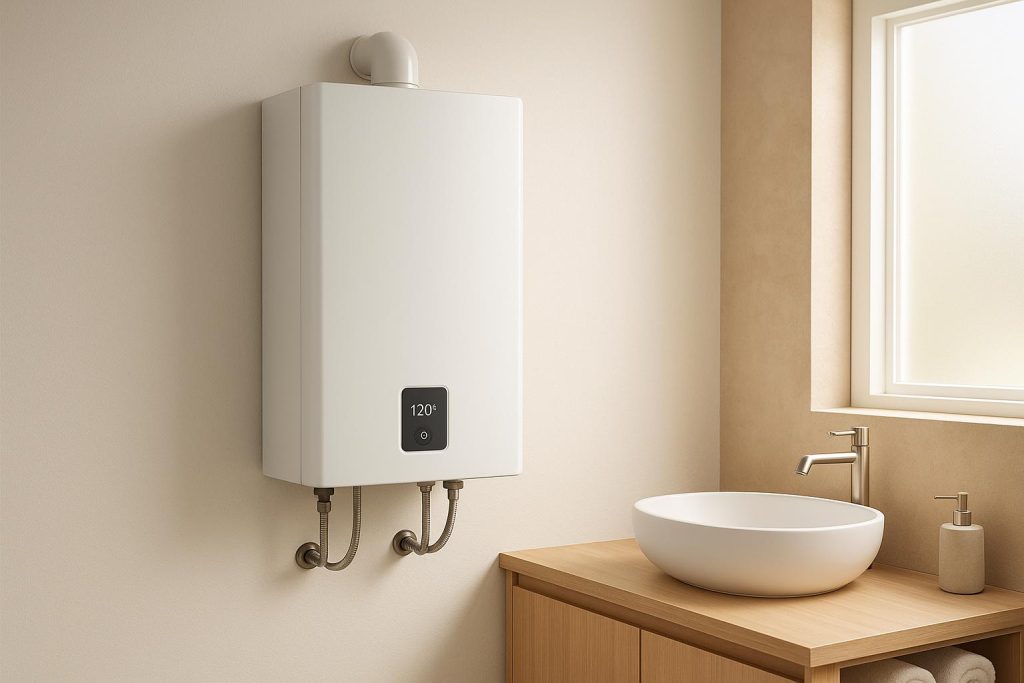
- ✅ Space-saving design, wall-mounted, roughly the size of a small suitcase
- ❌ $800–$2,500 higher upfront cost before credits
- ❌ Higher installation complexity, may need gas line, venting, or electrical upgrades
- ❌ Annual descaling required in hard water areas
- ❌ Brief cold water delay between back-to-back uses on some models
Tank Water Heater Pros and Cons
- ✅ Low upfront cost, $600–$1,400 installed for most homes
- ✅ Simple installation, most plumbers swap one in 2–3 hours
- ✅ Handles simultaneous demand without flow rate limitations
- ✅ Easy DIY maintenance, annual flush and anode rod check
- ✅ Works in all climates and water conditions
- ❌ Standby heat loss, paying to keep 40–50 gallons hot around the clock
- ❌ 8–12 year lifespan, at least one replacement in a 15-year window
- ❌ Higher long-term energy bills, $100–$300/year more than tankless
- ❌ Finite supply, drain the tank and you wait 30–60 min for recovery
Which Is Better for Your Home Size?
Go Tankless If:
- You plan to stay in the home 8+ years
- Your household uses hot water heavily, multiple bathrooms, daily laundry, dishwasher running regularly
- Local energy rates are above national average ($0.16/kWh electric or $1.20/therm gas)
- You want to capture the 2026 federal tax credit before it expires
- You’re doing a full bathroom renovation or home addition
Stick With a Tank If:
- You’re on a tight budget and can’t absorb the $1,500–$2,500 upfront premium
- You’re selling the home within 3–5 years
- Your gas lines are undersized and upgrading adds $400+ to the cost
- You live in a very cold climate where ground water regularly drops below 40°F
For a 2-person household in a mild climate? A tank heater is often the smarter financial move. For a 4–5 person household with high hot water demand, above-average energy rates, and a long ownership plan, tankless wins on lifetime tankless vs. tank water heater cost.
Once you’ve picked a type, brand matters. Check out our Rheem vs. AO Smith water heater comparison or our gas vs. electric water heater cost breakdown if you’re still deciding on fuel type.
FAQ: Tankless vs. Tank Water Heater Cost
How much does it cost to switch from a tank to a tankless water heater?
Switching from a tank to a gas tankless water heater typically costs $1,500–$3,500 for the unit and installation. If gas line or venting upgrades are needed, add $300–$1,200 more. Electric tankless conversions run $800–$2,300 all-in. See our electric water heater installation cost guide for the full breakdown.
Is a tankless water heater worth the extra cost?
For most homeowners staying 8+ years, yes. The average 15-year savings runs $2,500–$3,500 depending on usage and local energy rates. Factor in the 2026 federal tax credit ($300–$600 for qualifying gas tankless) and the payback drops to 4–8 years. If you’re selling within 3–5 years, the math doesn’t work, stick with a tank.
How long does a tankless water heater last compared to a tank?
Tankless water heaters last 15–25 years with proper maintenance. Tank water heaters average 8–12 years. Over 20 years, you’d replace a tank heater at least once, adding $800–$1,500 to its lifetime cost. Read our guide on tankless water heater maintenance and inspection to maximize your unit’s lifespan.
Does a tankless water heater qualify for a tax credit in 2026?
Yes. Gas tankless water heaters meeting UEF ≥ 0.95 qualify for a 30% federal tax credit up to $600 through December 2026. Heat pump water heaters qualify for up to $2,000. Both credits come directly off your federal tax bill, not as a deduction.
What size tankless water heater do I need for a family of 4?
A family of 4 typically needs a unit rated for 8–10 GPM (gallons per minute). In colder climates where ground water drops below 50°F, size up to 10–12 GPM to maintain output under peak demand. A licensed plumber can calculate your exact flow rate needs based on fixture count and simultaneous usage.
Can I install a tankless water heater myself?
Gas tankless units require a licensed plumber and, in most states, a licensed gas technician. DIY installation voids most warranties and creates real safety risks. Electric tankless models are more approachable but typically still need a licensed electrician if panel upgrades are required. Don’t DIY the gas work, it’s not worth it.
The Bottom Line on Tankless vs. Tank Water Heater Cost
Tankless water heaters cost more upfront, that’s just the reality. But over 15 years, the math clearly favors tankless for most homeowners who stay put long enough to capture the savings. It’s also worth checking whether homeowners insurance covers water heater damage before your old unit gives out.
The sweet spot: a gas tankless unit in a home with 3–5 people, decent energy rates, and an 8–10+ year ownership plan. Add the 2026 federal tax credit and you’re looking at a 5–7 year payback and $2,500–$3,500 in lifetime savings over a tank. Heat pump water heaters, a third option worth considering, qualify for a federal tax credit of up to $2,000 in 2026.
If you’re shopping right now, the smartest move is to get a free quote from a local plumber. They can assess your gas line, water pressure, household flow requirements, and tell you exactly which unit, and which upgrades, are actually worth budgeting for.